
Was Yankee Jim Executed Unjustly? And Is That Why He Still Haunts the Whaley House?
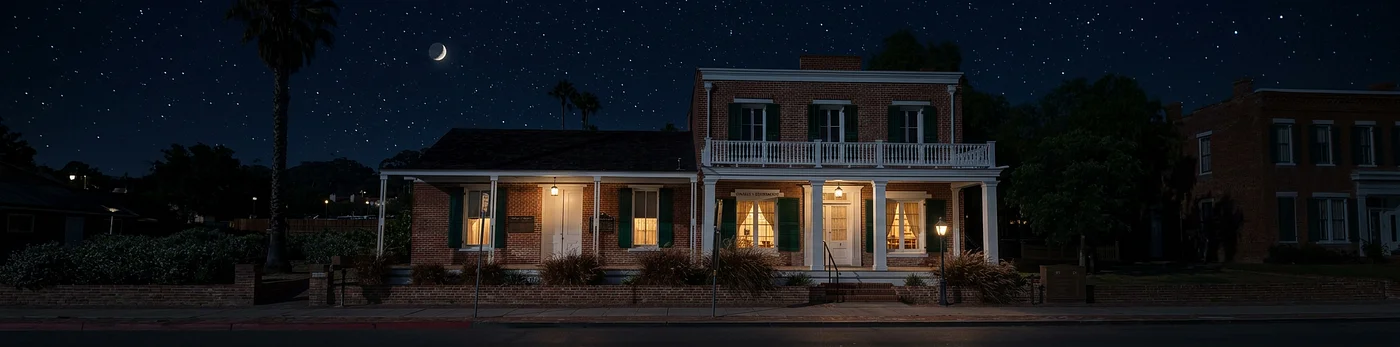
The Execution of "Yankee Jim"
If there's one ghost tied to the Whaley House that deserves a second look, it's not Thomas Whaley or his daughter Violet. It's James "Yankee Jim" Robinson.
Every ghost tour tells you he was a thief who was hanged on the property before the house was built. But the deeper I looked into his story, the more I started wondering if that's really the whole picture.
Yankee Jim absolutely committed crimes. He attempted to steal a boat and had developed a reputation as a troublemaker in the young settlement of San Diego. But here's what stands out: the punishment didn't fit the crime.
Frontier justice in 1852 wasn't exactly known for restraint. San Diego had barely become an American city, and the legal system was still finding its footing. A jury that included two of the boat's owners sentenced Robinson to death. Today, hanging someone for attempted grand larceny sounds almost unimaginable, but even by the standards of the time, historians have argued that his execution was unusually severe.
Then came the execution itself
Yankee Jim stood six foot four, an extraordinary height for the 1850s. The gallows weren't built with that in mind. When the wagon rolled away beneath him, he didn't die from a clean drop. His boots scraped the ground as he slowly strangled in front of a crowd. Among the witnesses was a businessman named Thomas Whaley. Five years later, Whaley would build his family home on that very spot.
Almost immediately after moving in, Thomas began hearing heavy footsteps upstairs. He didn't blame settling timbers or an overactive imagination. He believed they belonged to Yankee Jim.
Could Thomas have simply been haunted by what he witnessed that day? Absolutely. Watching someone die that way would leave a mark on anyone. But what's difficult to dismiss is that the reports didn't stop with Thomas. For more than 160 years, visitors have continued describing heavy footsteps, sensations of choking near the original gallows site, and an unexplained feeling on the ninth step of the staircase.
Was Yankee Jim an Example?
I'm not convinced Yankee Jim was an innocent man. The historical record doesn't support that. But I do think there's a strong argument that he became a symbol of frontier justice at its harshest. He wasn't a murderer. He wasn't a notorious outlaw. He was a petty criminal whose life ended publicly in a way that many historians now view as disproportionate to his crimes.
If spirits linger because of unfinished business, resentment, or injustice, then Yankee Jim has one of the more compelling cases in paranormal history.
I also find it ironic the house eventually became a court house.
Whether the footsteps belong to him or not, his story deserves to be remembered for more than just being the ghost who haunts the Whaley House. Before he became part of one of America's most famous hauntings, he was a man whose final moments may have said as much about the justice system of frontier California as they did about anything supernatural.
If you want to hear the complete history of the Whaley House, including the Whaley family tragedies, the documented hauntings, and the investigations that continue today, check out my latest episode of Paranormal Unsettled. Listen with the lights on.
- Johnny Clash